Posts

Charles Correa - Mythic Image
Image
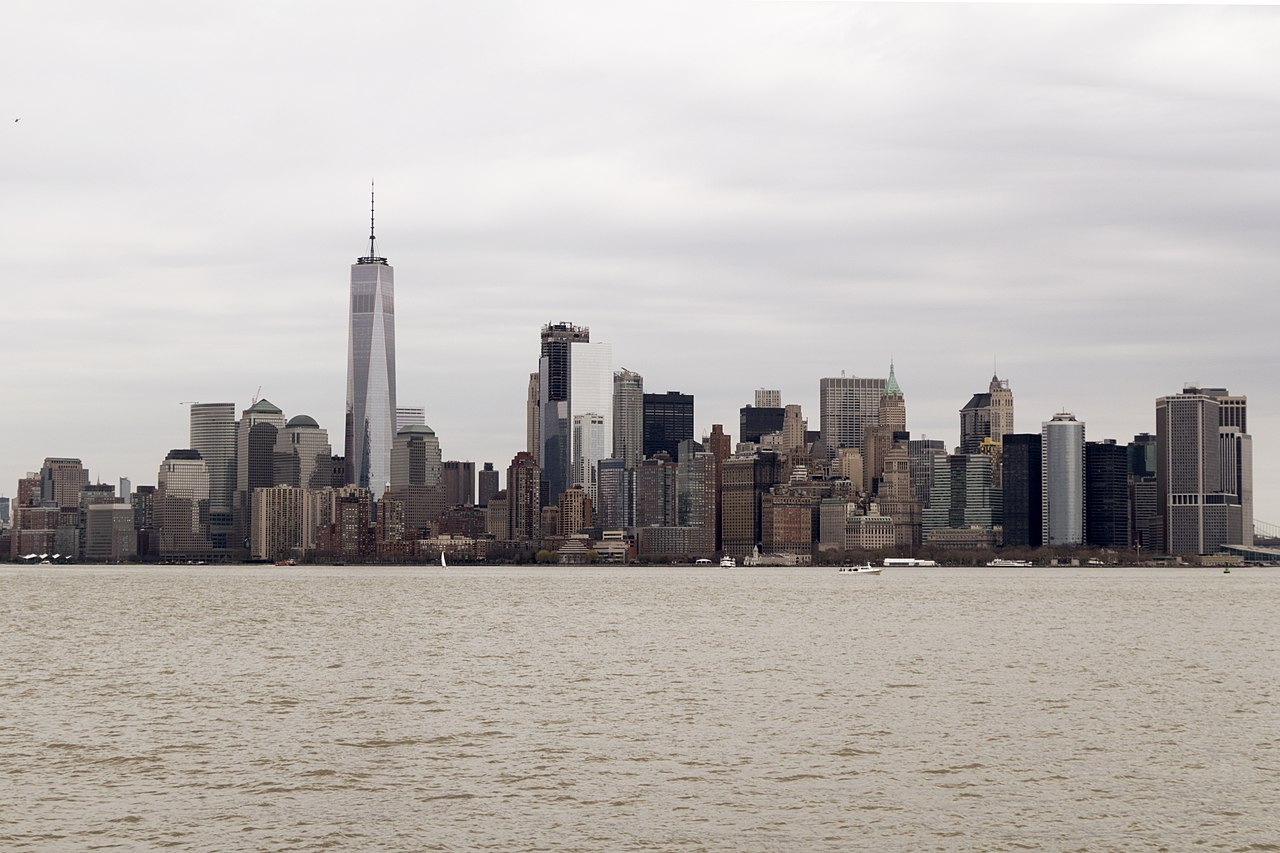
Manhattan New York as seen from a boat returning from Ellis Island by John Salatas, 15 April 2017. Retrieved from Wikipedia Commons. This essay is in continuation to reviewing A Place in the Shade by Charles Correa.  The essay starts by letting us know that Correa has become a part of the steering committee in the Aga Khan award. This opens him up to the contemporary outlook of the architectural professional.  Correa asks what the mythic image is, and the value it holds in the mind of the architect. In a way, it's an extremely helpful ruck sack of ideas and concepts that an architect relies on to come up with solutions for the design. But, at the same time, is a curse that limits the architect to critically look at the site and the context that needs addressing. Constantly with Correa, we see him value and fall back on this topic of site context and its climate. Correa refers to Islamic architecture and its spread to the east and how it moulded and reinvented itsel...
Decoding Le Corbusier through Charles Correa (Part 2)

Image
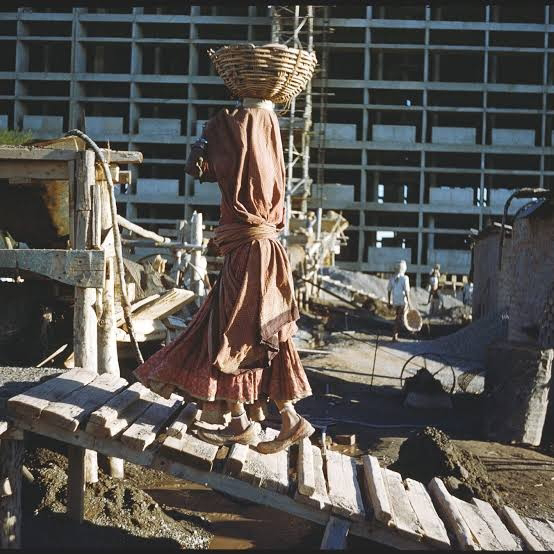
In 1956, a woman carries cement at Le Corbusier’s Capitol Complex, Chandigarh, India, in front of the Secretariat. Photograph by   Ernst Scheidegger, via Museum of Modern Art, New York. This is in continuation to reviewing Charles Correa's book, A Place in the Shade.   At 'Celebrating Chandigarh' symposium 2002, Correa finds himself talking and explaining about the need and the sheer stroke of genius that Corbusier was. And how lucky India was to invite and involve this great architect and visionary in its inception as a country. It is no doubt that Corbusier's involvement paved the path to all modern architecture in India but the amazing fact was that he respected India's culture, something Correa also values in his principals. Corbusier through this, was able to build the new architectural style that put India in the cutting edge of architectural marvels; where architects from around the world were trying to replicate this technology and design seen in...

Decoding Le Corbusier through Charles Correa (Part 1)

Image
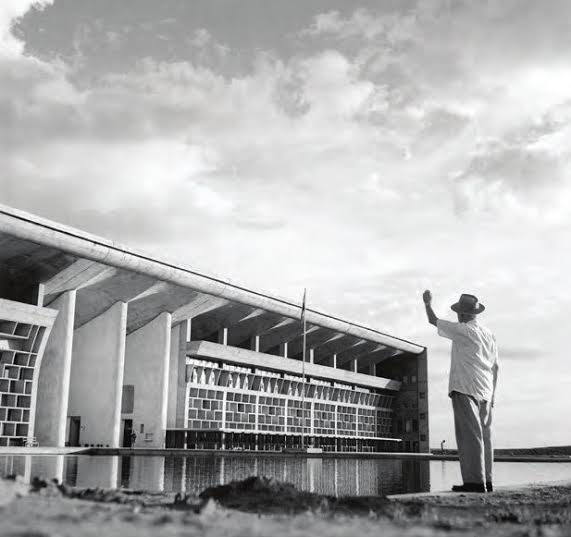
(Above) Le Corbusier looking towards the High Court Building’s main façade. This is continuing the review of essays by Charles Correa in his book, A Place in the Shade.  To claim that Correa is a free thinker would be an understatement. The man can be both, a harsh critic and a benevolent supporter and for the case of Le Corbusier here, he is both Through Chandigarh's Capital Complex, Correa strips Corbusier of every layer showing every little sentiment the man shared in designing buildings and what he seemingly ignored in his quest. Corbusier had the task of making this newly independent country's newest city, all the while establishing the language of architecture for the coming future.  Correa introduces himself to the reader before the critique and praise of Le Corbusier, in a way that gives credibility to the man. From the ideals of climate, culture, material, design and more. Charles Correa is no preacher, but the embodiment of a practitioner with a rich set ...

A Place in the Shade by Charles Correa - Introduction

Image
As I sat down with a copy of the Place in the Shade and read the introduction text by Correa, it prepared for the journey through the thoughts of the Greatest Architect of India. Correa's words stand as strong as time itself as I would realise while reading this book. Knowing full well that I'll have to read this at different points of my life; and that with every read, Correa would tell me something new every time through those same string of words. Correa starts off the book with a superhero origin like story of the phenomena that unknowingly shaped him into the designer at the world knows him now as. Correa talks about the skill of imagination as a child customizing train tracks into complex layouts for his amusement and softly transitions to the topic of architectural design while traversing the topics of film, drama, Chinese gardens and interior design here we see Charles Correa, someone who has practiced and mastered the use of the Ritualistic Pathway talk abo...

The New Landscape by Charles Correa, 1985

Image
The following are some thoughts and ramblings that went across my mind when reading the The New Landscape by Charles Correa. Picking this book up after my completion of the course of architecture was a huge tragedy. I can only imagine how much of a better sensitivity and realness my designs could have portrayed in their conception, which eventually were superficial at best. The book is rightfully said as a must read for every architect/planner willing to practice in India and the ideas and lens of critical thinking are a boon to the profession.  The fact with building the urban world is the higher density that comes along with it. And to bring this to reality, to build forms of over 4 stories, exponentially increases the cost of construction due to the use of RCC. This ultimately marks the price of housing to rise leading to the outcome being only  affordable to the upper and middle class, forcing the lower class to move to the street.  Indian cities, for exam...

Charles Correa used film as a medium to raise awareness around urban issues

Image
Ever since the expansion of transport networks, cities have become one of the most versatile machines for human advancement. And as time has moved on, so has the mass and numbers of these highly efficient cities around the globe. Along with this massive growth, fallacies in this machine have become apparent. The study of urban architecture sought to understand and regulate the exponential spread of cities and made an effort into bettering the lives of the people, who serve as cogs in the city infrastructure. Charles Correa’s high intellect and excellent observation skills are well known through his works, but another remarkable skill of Correa was the language in which he was able to communicate his learnings to others. An architect is disconnected from the commoners, the use of complex drawings and language structure feels alienating except for the members of the architecture fraternity. Correa observed that at the face of any urban issue, the stakeholders that get hit the hardest are...

THE LITERARY SPACE

  What happens after one is cremated? Why only go for cremations? What is the path to salvation? Many questions wander around the minds of those who visit or hear about the spaces of death. For the curious and the lost, a repository of Vedic and scientific knowledge that gives answers in spirituality and ecological sciences. A far cry from the programme of the crematorium, the space is meant to be isolated and introverted to disconnect the user from the sites happenings, and while providing a safe haven. *** Read Utsav's Design Dissertation titled 'Dignity in Death: A crematorium design thesis', click the link here . Watch the Dissertation jury presentation video here .  Watch the final design presentation here . 

THE CREMATION SPACE

  THE CREMATION SPACE When a diya gets lit, the hand instinctively protects it from the wind. Similarly, the cremation service is the last service to their loved one, where the person takes the responsibility of conducting the required rituals, cremating the body wholly and scattering the ashes in a holy water body. The cremation space allows these activities to be held while allowing for massive congregations around the deceased. The walls around it, like arms protecting the flame and the people in it from the elements outside. *** Read Utsav's Design Dissertation titled 'Dignity in Death: A crematorium design thesis', click the link  here . Watch the Dissertation jury presentation video  here .  Watch the final design presentation  here . 

THE TEMPLE BLOCK

As torrential rain begins to envelop the city, people of Vrindavan seek the help of Krishna to save their families and belongings. Krishna responds by lifting Govardhan lift atop his little finger and providing every villager and animal a place under it for seven consecutive days. The temple complex was envisaged as a memorial of the story where elements from the feat were personified as the form of the temple complex. God’s presence in the times of doubt and fear is comforting. For the group of people arriving into the crematorium, just after suffering the loss of their loved one, being under the watchful eyes of the Almighty stills a nature of being looked after. The massing had to be light to be fitting of the puranic proportions. Wooden joists were stacked atop one another, with each subsequent course corbelled to give the impression of the hill (construction technique reference, Yusuhara Wooden bridge museum, Kengo Kuma and Associates). The central support houses the idol and ...

Religion = Commodity?

Image
  Imagine, opening up your future newspaper, or before your youtube video starts, you see an advertisement, trying to sell you a prestigious ticket to become a member of a particular religion. "With the idea of Recycle and Reuse becoming popular, allow your soul to be a part of it by accepting Hinduism!!" Or on the contrary think of your favourite influencer/actor telling you how great Christianity is because you can wear a beautiful white gown and get married in a church, only at the price of accepting Christ as your lord and saviour.  All this sounds extremely ridiculous, far-fetched and maybe even insulting. Religions, are considered as pious and untouched guides to our morality and are famous for teaching its followers to be loyal to it. These being defined through centuries of human life on earth and also above it to answer what comes before and after it all. However, for an off chance, can they be commoditized ? and in turn be sold to you? For their inherent benefits?...

The purpose behind the m̵̨͈̬̲̝̓͗̅͋͐͗̈́̎͆̓͜ͅả̸̱̩̙̩̮͎͊d̶̨͓͖͈̱̪͕͂n̸̢̧̼̯̺̼̫͔̬̾̒ẻ̴̱͍̰̗̮͕̲̃͛͌̎̓͛̕̚s̷͕̉̿̈́͛͛̈́̃͝s̴̈̆̋̕͜

Image
What makes something seem wrong? seem scary? or seem dark? I dont really have an answer for that. Sometimes, the general consensus answers it for me, expressing a particular piece is specially twisted or worse than the usual (in a good way ofcourse) Its funny how the whole exercise started, I always wanted to practice anatomy, get better in sketching. But instead of taking the typical path of drawing hundreds of eyes, hands in graceful positions or drawing famous faces; I chose this method, as it would've given me the same type of practice also any thing mangled or mutilated covered up my lack of skill. After more than 50 drawings, there has been an improvement, and has manifested my linear thought process of coming up with a certain pose, and then editing it to make it uncomfortable. Glaring errors usually make the drawings look really novice, even seem like cringy edgl0rd sketches.  It is amazing that a form that we are so well aware and used to knowing, seeing, feeling that too ...

The Irishman (2019)

Image
  “I heard you paint houses, Frank?” “Yes sir I do, and I do my own carpentry too.” -         The Irishman (2019) The tale of time and power, contract serial killer, mobster and a friend; Frank Sheeran’s rise and absolute demise are all visualised and narrated through the old man himself; engaging in the revelling story of friendship, loyalty and protection. Starting from its many metaphors serving as foreshadowing of the approaching end, return back to haunt him. The POWs digging their graves, on the face of death. The rotting smell of the fish being a smug nod to “something fishy” and the now tainted morality of Frank.  A story where Scorsese chooses to showcase deaths being cold, quick and like clockwork, commenting on the detached psyche and “Its time” acceptance of Frank, completely devoid of honour and emotion. Only ignored for Jimmy Hoffa, his friend and Sally Bugs, a bad hit. The editing choice to introduce side characters with ...

UN- CAGE: The bird feeder

Image
  UN- CAGE: The bird feeder Dont you hate it when the semester is over, the jury was as humiliating as it can be and worst of all youre still left with the model that you sinked more than 5k ruppees on? Atleast the sheets with your mediocre drawings can be stashed away, but this model HAS to stand the test of time and be the proof against time of your work. Nah, not really, it just acts as a constant reminder of how you cannot be a designer like your idols you dream of. Well worry not, my friend! Use the models base to repurpose it for something worthwhile. If the base is contoured, the bird poop might just slide off it (depending on the slope obviously!). Since you failed to provide a space for humans to live in, doesn't mean its completely inhabitable. Just let little birdies live, feed and breed in it. You can even list it as a sustainable project in your portfolio, that your employer would just brush past with no consideration. Use some of the wooden sticks they make you buy i...

The sacred space - Competition entry

Image
A Sacred space is a derivation of an individual’s belief. With the coexistence of multiple religions around the globe, the definition of a sacred space has diluted down to mean the same as a holy space, which isnt true. The idea of being sacred is achieved in a sense of tranquility, compassion and bliss with oneself and the attitude towards others. Its a space that incubates love and conciousness. It serves to deviate hatred from the hearts and convinces the individual to embrace and to realise. A sacred architectural space must strive to achieve all this in the terms of its motive, scale, form, material and accessibility. Architecture serves the purpose of a symbol for its users and if the symbol achieves this level of purity and cognition, then it can being to serve to motivate the users within it.  Zoroastrianism is a one of the oldest faiths still being practiced in the present. Called the Parsis, they saw persecution from the Islamic invasions and sought refuge in India and ot...

The pandemic and our urban habitat - Essay

Image
 Collage by Utsav Chaudhury B efore the pandemic entered India, I was busy completing the remainder of my 90 day internship in Goa; with dreams of leaving work and exploring Goa for the month of May. Alas to my surprise, the lockdown came into effect and along with it the absolutely confusing months of March and April where everyday was going into a forest, hunting and gathering for the week’s supply of vegetables, spices, Maggi and others. It was a situation like no other and to my good fortune I had moved into a new apartment with 3 new roommates, which meant we could divide in groups of two and distribute the shopping list amongst each other. Alternate days of coming back from the ‘hunt’ and laying all our food down on the balcony floor for it to sanitise under the sun rays while we tallied up and divided the expenses amongst ourselves was our new normal. Although it is no doubt an extremely scary and panicking situation, where the basic necessity of everyday food wasn't readily...