Posts

Showing posts with the label architecture

My Balcony, looking inward

Image
There used to be a time when I lived more on my balcony than inside my room. Now I sit down in the same spot on my study table, facing the window, trying to look out through the negative spaces between the drying clothes. As days go by, I miss how the outside of my window used to look. When I was 12, my family unanimously decided to annexe the balcony into our rooms. On paper it was a great idea; the balconies were tiny and any added space in our small rooms would be awesome. I recall the process of this annexure, with numerous masons working in the house, demolishing a few existing walls and then constructing new walls and windows. I remember thinking how astronomically huge the rooms felt to me at that age, although the extension was barely 2.5 feet in width. I would frequently play cricket in that tiny extension, with no clue of what I had lost. Another 13 years later, now I feel we didn't gain much, the rooms are darker, the quality of space in the house feels low and we have b...

My journey in design (till July 2025)

Image
This essay was drafted as a response to the question "What was your initial idea about design?" during the introductory sessions in NID Ahmedabad . Dated July 2025. Design as an architecture student was to design buildings at the end of the day. A well-designed building was climatically efficient while being geometrically and visually pleasing. We were taught design as something scientific, where material constraints and space use needed to be understood. Every drawing was meant to address all human activity and needs, while balancing client requirements and aspirations. Design became a formula to achieving the fundamentals to a good building. Although we were taught how design borrows from art, it was never a comparison between the two; architecture was different and superior. As I worked in Charles Correa Foundation (An organisation dedicated to keeping the ideas of the imminent post-independence Indian architect relevant) I was opened to the social role of architecture an...

My visit to the Gun House, Ahmedabad by Charles Correa

Image
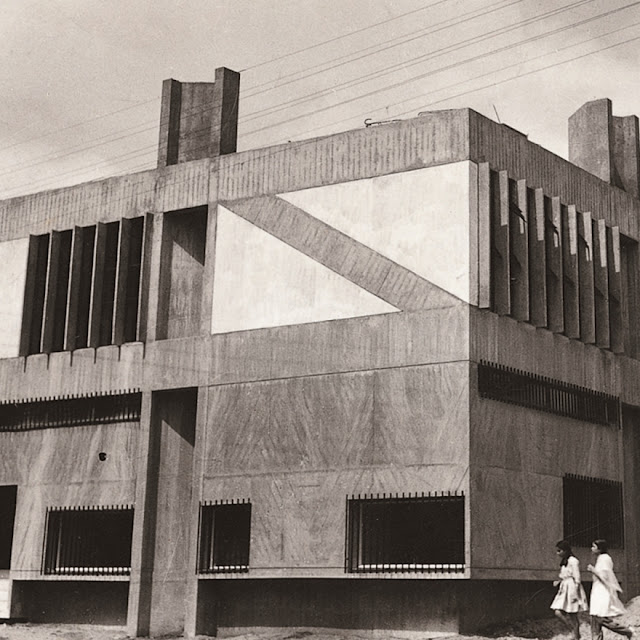
 Gun House as built in 1960, copyright Charles Correa Associates, courtesy of Charles Correa Foundation * After wrapping up my fellowship at the Charles Correa Foundation in Panaji, Goa, I needed a time-off to think about what I was going to do next. After listening to about a hundred different versions of my future from everyone around me, and disagreeing with all of them, I returned back home only to quickly elope to Gujarat for a well-earned time off. Amongst the places I got to visit & the people I got to spend time with, one experience took centre stage for me. Working on the Correa Archive, I had developed a good understanding of Correa’s work. One such was the Gun House, and knowing I will be so close to it on this trip; I had to make it a must to go and see it. The idea of the Gun House, from its name, shape, to the stories of its current fate brought tremendous interest to my mind. It is rare to see a work of a significant architect that goes through such massive deg...

Charles Correa - Mythic Image

Image
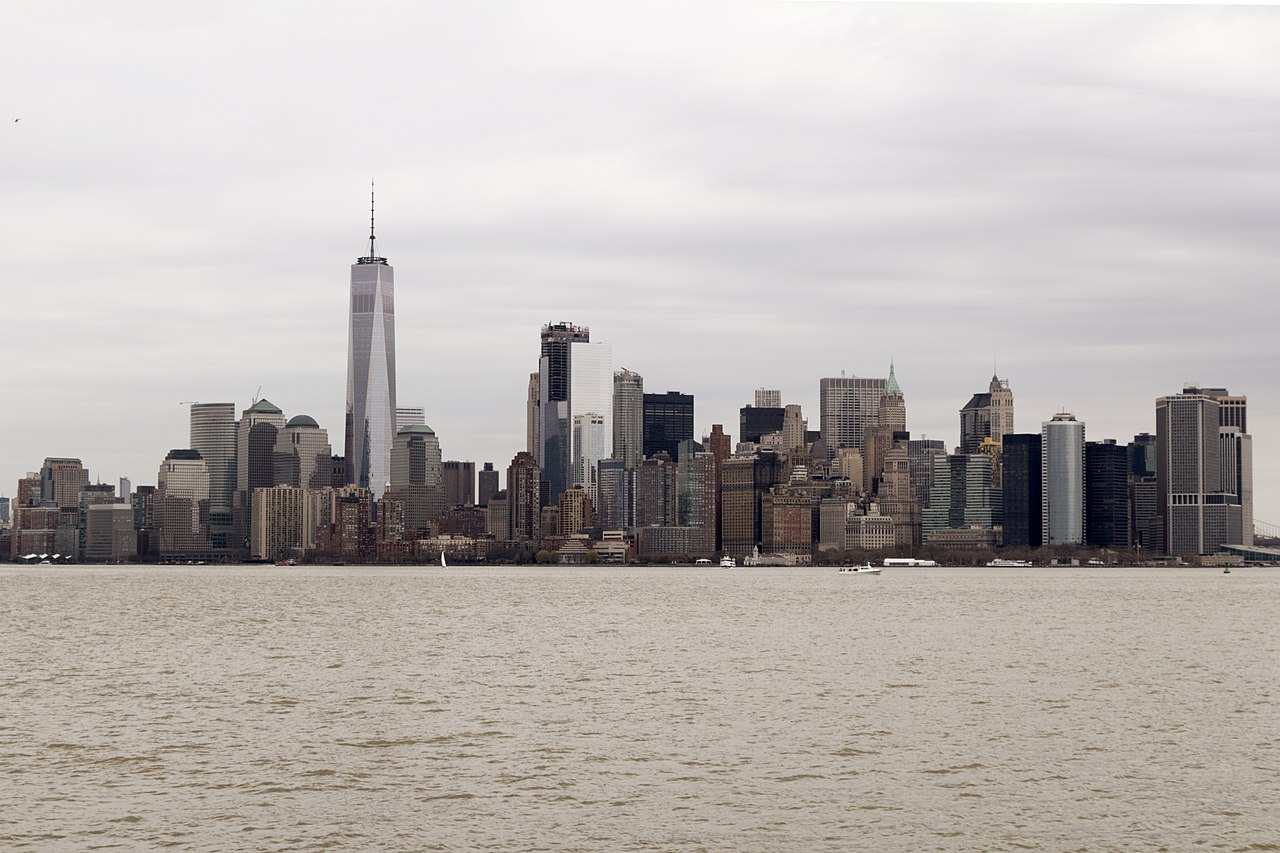
Manhattan New York as seen from a boat returning from Ellis Island by John Salatas, 15 April 2017. Retrieved from Wikipedia Commons. This essay is in continuation to reviewing A Place in the Shade by Charles Correa.  The essay starts by letting us know that Correa has become a part of the steering committee in the Aga Khan award. This opens him up to the contemporary outlook of the architectural professional.  Correa asks what the mythic image is, and the value it holds in the mind of the architect. In a way, it's an extremely helpful ruck sack of ideas and concepts that an architect relies on to come up with solutions for the design. But, at the same time, is a curse that limits the architect to critically look at the site and the context that needs addressing. Constantly with Correa, we see him value and fall back on this topic of site context and its climate. Correa refers to Islamic architecture and its spread to the east and how it moulded and reinvented itsel...

Decoding Le Corbusier through Charles Correa (Part 2)

Image
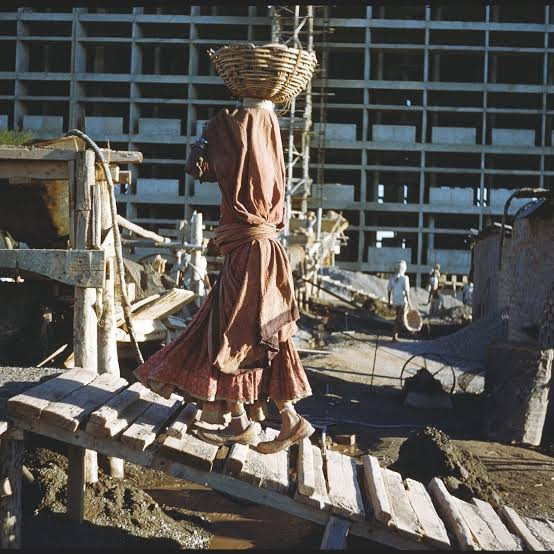
In 1956, a woman carries cement at Le Corbusier’s Capitol Complex, Chandigarh, India, in front of the Secretariat. Photograph by   Ernst Scheidegger, via Museum of Modern Art, New York. This is in continuation to reviewing Charles Correa's book, A Place in the Shade.   At 'Celebrating Chandigarh' symposium 2002, Correa finds himself talking and explaining about the need and the sheer stroke of genius that Corbusier was. And how lucky India was to invite and involve this great architect and visionary in its inception as a country. It is no doubt that Corbusier's involvement paved the path to all modern architecture in India but the amazing fact was that he respected India's culture, something Correa also values in his principals. Corbusier through this, was able to build the new architectural style that put India in the cutting edge of architectural marvels; where architects from around the world were trying to replicate this technology and design seen in...

Decoding Le Corbusier through Charles Correa (Part 1)

Image
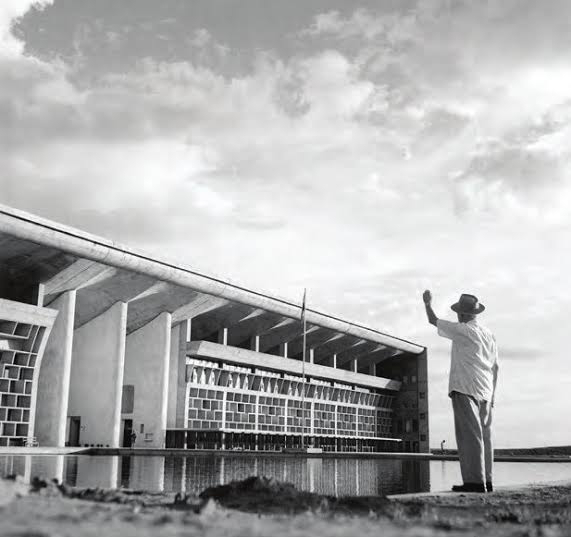
(Above) Le Corbusier looking towards the High Court Building’s main façade. This is continuing the review of essays by Charles Correa in his book, A Place in the Shade.  To claim that Correa is a free thinker would be an understatement. The man can be both, a harsh critic and a benevolent supporter and for the case of Le Corbusier here, he is both Through Chandigarh's Capital Complex, Correa strips Corbusier of every layer showing every little sentiment the man shared in designing buildings and what he seemingly ignored in his quest. Corbusier had the task of making this newly independent country's newest city, all the while establishing the language of architecture for the coming future.  Correa introduces himself to the reader before the critique and praise of Le Corbusier, in a way that gives credibility to the man. From the ideals of climate, culture, material, design and more. Charles Correa is no preacher, but the embodiment of a practitioner with a rich set ...

A Place in the Shade by Charles Correa - Introduction

Image
As I sat down with a copy of the Place in the Shade and read the introduction text by Correa, it prepared for the journey through the thoughts of the Greatest Architect of India. Correa's words stand as strong as time itself as I would realise while reading this book. Knowing full well that I'll have to read this at different points of my life; and that with every read, Correa would tell me something new every time through those same string of words. Correa starts off the book with a superhero origin like story of the phenomena that unknowingly shaped him into the designer at the world knows him now as. Correa talks about the skill of imagination as a child customizing train tracks into complex layouts for his amusement and softly transitions to the topic of architectural design while traversing the topics of film, drama, Chinese gardens and interior design here we see Charles Correa, someone who has practiced and mastered the use of the Ritualistic Pathway talk abo...

The New Landscape by Charles Correa, 1985

Image
The following are some thoughts and ramblings that went across my mind when reading the The New Landscape by Charles Correa. Picking this book up after my completion of the course of architecture was a huge tragedy. I can only imagine how much of a better sensitivity and realness my designs could have portrayed in their conception, which eventually were superficial at best. The book is rightfully said as a must read for every architect/planner willing to practice in India and the ideas and lens of critical thinking are a boon to the profession.  The fact with building the urban world is the higher density that comes along with it. And to bring this to reality, to build forms of over 4 stories, exponentially increases the cost of construction due to the use of RCC. This ultimately marks the price of housing to rise leading to the outcome being only  affordable to the upper and middle class, forcing the lower class to move to the street.  Indian cities, for exam...

UN- CAGE: The bird feeder

Image
  UN- CAGE: The bird feeder Dont you hate it when the semester is over, the jury was as humiliating as it can be and worst of all youre still left with the model that you sinked more than 5k ruppees on? Atleast the sheets with your mediocre drawings can be stashed away, but this model HAS to stand the test of time and be the proof against time of your work. Nah, not really, it just acts as a constant reminder of how you cannot be a designer like your idols you dream of. Well worry not, my friend! Use the models base to repurpose it for something worthwhile. If the base is contoured, the bird poop might just slide off it (depending on the slope obviously!). Since you failed to provide a space for humans to live in, doesn't mean its completely inhabitable. Just let little birdies live, feed and breed in it. You can even list it as a sustainable project in your portfolio, that your employer would just brush past with no consideration. Use some of the wooden sticks they make you buy i...

The sacred space - Competition entry

Image
A Sacred space is a derivation of an individual’s belief. With the coexistence of multiple religions around the globe, the definition of a sacred space has diluted down to mean the same as a holy space, which isnt true. The idea of being sacred is achieved in a sense of tranquility, compassion and bliss with oneself and the attitude towards others. Its a space that incubates love and conciousness. It serves to deviate hatred from the hearts and convinces the individual to embrace and to realise. A sacred architectural space must strive to achieve all this in the terms of its motive, scale, form, material and accessibility. Architecture serves the purpose of a symbol for its users and if the symbol achieves this level of purity and cognition, then it can being to serve to motivate the users within it.  Zoroastrianism is a one of the oldest faiths still being practiced in the present. Called the Parsis, they saw persecution from the Islamic invasions and sought refuge in India and ot...