Posts

Showing posts with the label urban

My Balcony, looking inward

Image
There used to be a time when I lived more on my balcony than inside my room. Now I sit down in the same spot on my study table, facing the window, trying to look out through the negative spaces between the drying clothes. As days go by, I miss how the outside of my window used to look. When I was 12, my family unanimously decided to annexe the balcony into our rooms. On paper it was a great idea; the balconies were tiny and any added space in our small rooms would be awesome. I recall the process of this annexure, with numerous masons working in the house, demolishing a few existing walls and then constructing new walls and windows. I remember thinking how astronomically huge the rooms felt to me at that age, although the extension was barely 2.5 feet in width. I would frequently play cricket in that tiny extension, with no clue of what I had lost. Another 13 years later, now I feel we didn't gain much, the rooms are darker, the quality of space in the house feels low and we have b...
The fault in the Sassoon Docks Art Festival

Image
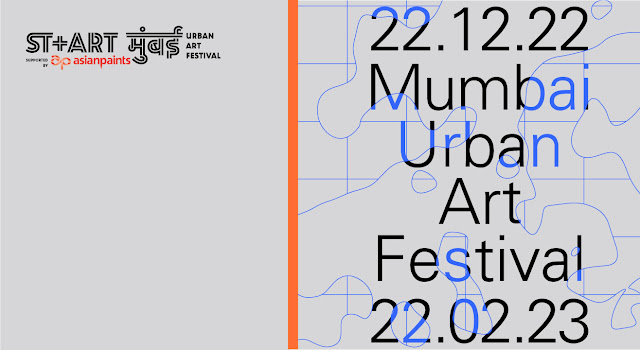
  Poster for the Mumbai Urban Art Festival 2022-23 by St+art Foundation retrieved from paytminsider.com Recently I had the fortune to visit the Mumbai Urban Art Festival 2022-23. This was the second year of the festival being hosted in Sassoon Docks, Mumbai. Sassoon Docks is a fishing port for the koli fishing community, which also includes a bustling fish market, fish related industries and car garages on the site. The art festival is beautifully integrated in the negative spaces of the site, existing in the voids of the daily. The art installations took visual-based forms, where the clear bias for Instagram bloggers was apparent. The installations retained their social message along with their visual flair. The festival in its nature is open-to-all. However, what was common to see an overarching majority of teen to young adult audience who were extremely eager to take a photograph for their social media platforms and covering as much ground as possible in the shortest amount of t...

My visit to the Gun House, Ahmedabad by Charles Correa

Image
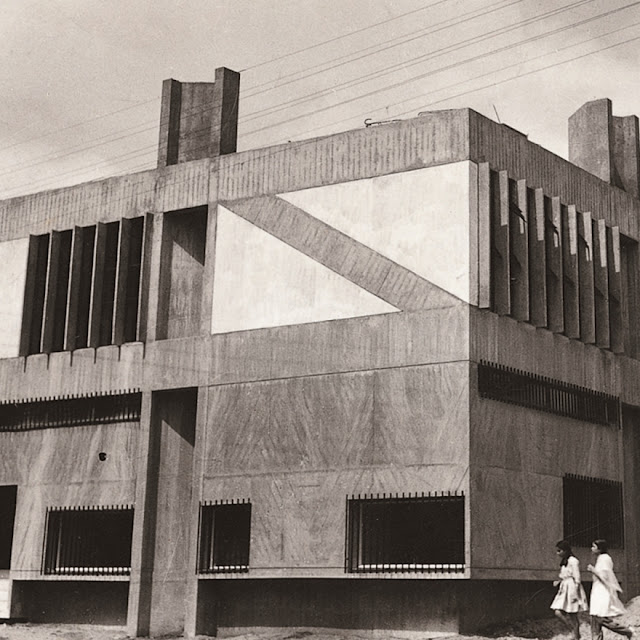
 Gun House as built in 1960, copyright Charles Correa Associates, courtesy of Charles Correa Foundation * After wrapping up my fellowship at the Charles Correa Foundation in Panaji, Goa, I needed a time-off to think about what I was going to do next. After listening to about a hundred different versions of my future from everyone around me, and disagreeing with all of them, I returned back home only to quickly elope to Gujarat for a well-earned time off. Amongst the places I got to visit & the people I got to spend time with, one experience took centre stage for me. Working on the Correa Archive, I had developed a good understanding of Correa’s work. One such was the Gun House, and knowing I will be so close to it on this trip; I had to make it a must to go and see it. The idea of the Gun House, from its name, shape, to the stories of its current fate brought tremendous interest to my mind. It is rare to see a work of a significant architect that goes through such massive deg...

The New Landscape by Charles Correa, 1985

Image
The following are some thoughts and ramblings that went across my mind when reading the The New Landscape by Charles Correa. Picking this book up after my completion of the course of architecture was a huge tragedy. I can only imagine how much of a better sensitivity and realness my designs could have portrayed in their conception, which eventually were superficial at best. The book is rightfully said as a must read for every architect/planner willing to practice in India and the ideas and lens of critical thinking are a boon to the profession.  The fact with building the urban world is the higher density that comes along with it. And to bring this to reality, to build forms of over 4 stories, exponentially increases the cost of construction due to the use of RCC. This ultimately marks the price of housing to rise leading to the outcome being only  affordable to the upper and middle class, forcing the lower class to move to the street.  Indian cities, for exam...